
Google Universal Cart: The End of Traditional E-commerce and How to Survive the Era of Agentic Commerce
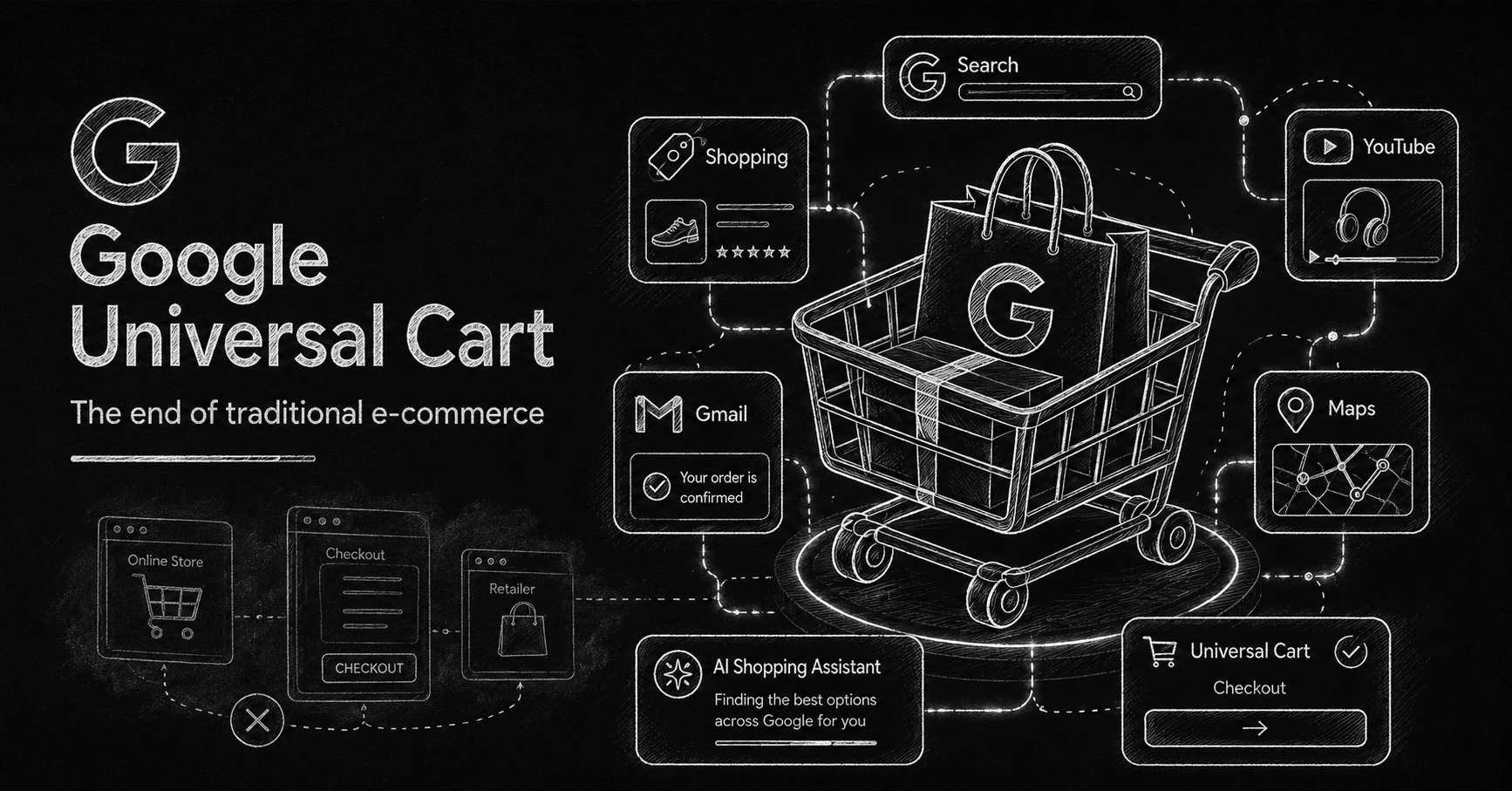
Picture this scenario: your potential customer is looking for new equipment or a specific product. Instead of opening ten different tabs, manually comparing prices, and registering on each site, they simply issue a command. Google's AI (Gemini) scans the entire web, finds the best deals, checks real-time inventory, automatically applies discounts from their digital wallet, and compiles everything into a single, global checkout - Google Universal Cart.
This is no longer a future prediction; it's the new reality. With the rise of "agentic commerce," the rules of e-commerce are being fundamentally rewritten. Consumers are beginning to delegate their shopping to AI agents working in the background, making the traditional "browsing" of online stores a thing of the past.
For you, as an online business owner, this technological leap harbors a massive, often invisible risk.
Artificial intelligence isn't impressed by your website's beautiful design or your expensive ad campaigns. It reads raw data - in milliseconds. If your store relies on outdated infrastructure that refreshes information slowly, or buries product details behind heavy, sluggish systems, Google's AI agent will simply bypass you.
Even if your product is better or cheaper, the AI will favor your competitor if their site delivers accurate data a fraction of a second faster. In this new era, if your store cannot communicate flawlessly with machines, you practically don't exist on the market.
Why Monolithic Platforms Are Becoming "Invisible" to AI
For years, businesses have relied on out-of-the-box, monolithic platforms and hundreds of plugins to run their stores. Today, these architectures are the primary reason stores are losing ground to AI. Here is where the core problems lie:
The Illusion of Caching
To appear fast to the human eye, mainstream platforms rely heavily on aggressive caching (displaying a saved, older version of a page). AI agents, however, hate inaccurate data. If Google's algorithm requests a real-time inventory check and your cache returns two-hour-old data (resulting in an out-of-stock error at checkout), your store will be penalized and disqualified from future queries.
Slow Server Response Time (TTFB)
Until now, optimization focused on how quickly images loaded on a screen. AI agents don't have eyes. All they care about is the Time to First Byte (TTFB) from the server via the API. If your database is weighed down by plugins and the server lags in its response, the AI will time out the connection and instantly redirect the sale to a competitor with a faster backend.
Loss of Control in the Cart
When your customer is in the Google Universal Cart, they see your product right next to your biggest competitors. If your system can't push an automatic discount, loyalty program perk, or exact shipping cost directly to Google's API, you lose the deal at the finish line.
The Old Model vs. AI-Ready Infrastructure
To stay competitive today, a website's infrastructure must transition from systems optimized solely for humans to systems optimized for artificial intelligence (Headless Commerce). Here is how the core components are changing:
- Data Refreshing: In traditional stores, this is slow and relies on periodic exports or caching. In an AI-Ready environment, everything happens in real time through direct API connections.
- Server Response (TTFB): Monolithic platforms are often sluggish due to heavy databases. Modern infrastructure ensures instantaneous responses thanks to Edge Computing.
- Optimization Focus: While the old model relies heavily on visual content and keywords (for the human eye), AI-Ready stores are structured around flawless JSON-LD data that the AI reads and understands perfectly.
- Scalability and Flexibility: Off-the-shelf platforms are limiting and slow down drastically with every new plugin. Custom architecture gives you the absolute freedom to implement complex business logic (like specific promotions and B2B discounts) without sacrificing speed.
How Studio Hivenapse Prepares You for the Future
At Studio Hivenapse, we don't just "build websites" - we engineer the technological infrastructure that turns your business into a leader in the era of agentic commerce.
An API-First Approach for Perfect Data
We develop fully custom e-commerce stores based on Next.js. This Headless architecture separates the visual frontend from the backend. The result? Your store communicates flawlessly with Google Merchant Center and Universal Cart, feeding perfectly structured data in real time, without compromise.
Edge Computing: Zero Seconds of Waiting
Using the modern technologies in our stack, your prices, inventory, and complex promotions are processed on servers physically located as close to Google's infrastructure as possible. This guarantees an instant server response. When the AI agent is searching for the best deal, your store answers first.
A Long-Term Business Investment
Migrating from a legacy platform to a custom Next.js solution isn't just a cosmetic upgrade. It's a strategic insurance policy for your business. By removing the reliance on fragile plugins, you get a system that converts better, doesn't crash during peak campaigns, and most importantly - sells successfully through Google's new AI channels.
Are You Ready for the New Era of E-commerce?
Agentic commerce isn't just a trend; it's the new standard dictating how market share is distributed. If your store isn't prepared to serve an AI with the same ease it serves humans, you are losing money every minute. Don't wait for your competitors to claim the top spots in Google's AI cart. Contact Studio Hivenapse today for a free technical audit of your current online store, and let's discuss how to build your AI-ready infrastructure.
Contact Us Now