AI-Ready Infrastructure: Why Monolithic Platforms Are Losing the Battle for Sales
For the past decade, the formula for a successful online store seemed straightforward: pick a popular out-of-the-box platform, buy a beautiful theme, add dozens of plugins for marketing and sales, and launch. That monolithic architecture worked perfectly for the Web 2.0 era.
Today, however, that same formula is a recipe for lost revenue.
With the rise of artificial intelligence and tools like Google Universal Cart, your store is no longer just competing for the human eye. It is competing for the attention of AI agents - intelligent bots that shop, compare, and make purchasing decisions on behalf of your customers in milliseconds.
Here is the harsh truth: monolithic platforms simply weren't built for this new reality. Here is why traditional systems are losing the battle, and why upgrading to an AI-Ready infrastructure is no longer a luxury, but a matter of survival.
The Monolithic Trap: Where Is Your Money Leaking?
Monolithic systems (where the frontend visual layer and the backend database are tightly coupled) have fundamental architectural limitations when serving artificial intelligence.
1. The "Frankenstein" Effect and Speed Collapse
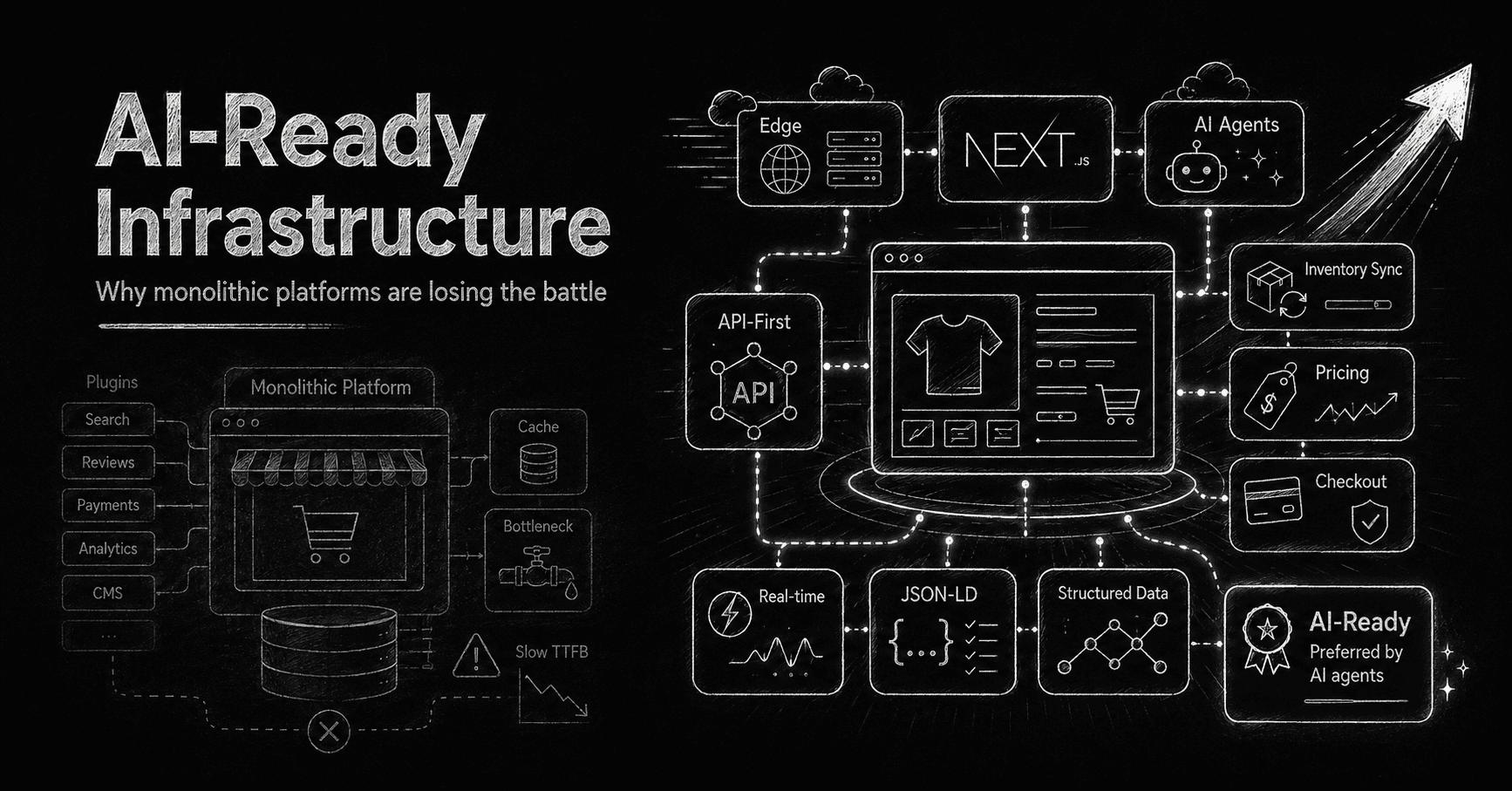
As your business grows, you add plugins - for discounts, email marketing, and complex shipping rules. Every new plugin adds weight to your database. The result is a sluggish server response time (TTFB - Time to First Byte). AI agents do not have human patience. If your server takes even half a second to process a request through all those plugins, Google's algorithm terminates the connection and offers your competitor's product instead.
2. The Caching Deception
To mask their slow nature, monolithic sites use aggressive caching. They take a static "snapshot" of the page and show it to the user. To a human, the site feels fast. To an AI agent, it is a disaster. Algorithms require absolute real-time data. If your cache tells Google a product is in stock at an old price, but it turns out to be sold out at checkout, your store gets flagged as an unreliable data source.
3. The Closed Ecosystem
Trying to force complex, business-specific logic (like dynamic B2B pricing based on user profiles) into an off-the-shelf platform often requires heavy compromises. The more you "bend" the platform, the more fragile it becomes during routine updates or traffic spikes.
What Does an AI-Ready Infrastructure Mean?
To serve both humans and artificial intelligence effectively, you need a fundamental shift in architecture - a move to Headless Commerce. This approach cuts the visual storefront away from the heavy backend database, allowing them to communicate solely through lightning-fast APIs.
Here is the difference between the two worlds:
🛑 The Old Model (Monolithic Store)
- Speed: Bogs down with every complex database query.
- Data: Relies on slow product feed exports and caching.
- Focus: Optimized to render HTML pages for the human eye.
- Result: Loses ground during automated queries from AI agents.
🚀 The New Model (AI-Ready with Next.js)
- Speed: Instantaneous server response via Edge Computing (data is processed on the server physically closest to the user and Google).
- Data: Real-time synchronization of inventory and pricing. AI sees the truth instantly.
- Focus: API-First approach - feeds perfectly structured data that machines love.
- Result: Your store becomes the preferred source for AI shopping carts.
Why This Is a Strategic Business Decision
Migrating to a fully custom infrastructure isn't just about adopting shiny new tech. It is about Return on Investment (ROI).
When we build online stores at Studio Hivenapse, we utilize Next.js to create an environment with zero bloat. This means your business gets the absolute freedom to build complex promotions and loyalty programs without sacrificing a single millisecond of load speed.
When your store feeds flawless data (via structured JSON-LD formats) instantly to Google Merchant Center and Universal Cart, you practically guarantee that your products will always be the algorithms' first choice. No server crashes during Black Friday. No lost sales due to broken plugins.
It Is Time for a Technological Evolution
If your current platform is giving you headaches today, it will cost you dearly tomorrow when AI agents dominate the market. Relying on legacy monolithic systems is like trying to win a Formula 1 race with a decade-old car. It is time to turn your store into a future-proof machine. Reach out to the Studio Hivenapse team for a technical audit and consultation. Let's discuss how migrating to a fully custom, AI-ready solution with Next.js can unlock the next stage of your business growth.
Contact Us Now